DIGITAL SAFE SPACE PROJECT

| RECRUITMENT OF A CYBERSECURITY TRAINING CONSULTANT SPECIALIZING IN THE PREVENTION OF CYBERBULLYING AND ONLINE SCAMS |
FEBRUARY 2026
| I. Background and Rationale |
As part of the Feminist in Action 2 (FEA 2) program, funded by the French Development Agency (AFD) and led by CARE, Women EdTech is implementing the subproject Digital Safe Space for the period from February through December 2026.
This subproject builds on the work carried out as part of the Feminist in Action 1 program, during which Women EdTech launched the Value’Her initiative, an innovative digital tool for preventing gender-based violence. This first phase made it possible to develop digital tools for raising awareness and providing guidance, produce educational content, engage young content creators, and build the capacity of women entrepreneurs, schoolgirls, and college students regarding the responsible use of digital technology.
However, rapid technological advances and the growing use of social media and digital platforms in Benin have led to an increase in technology-facilitated gender-based violence. (VBG-FT). The most common forms include digital blackmail, threats and intimidation, account hacking, cyberbullying, sextortion, identity theft, and online financial scams. This violence directly affects the safety, mental health, dignity, and economic well-being of women, particularly those who use digital tools as part of their entrepreneurial or academic activities.
While Phase 1 of the FEA has led to significant progress in raising awareness and mobilizing the community, the needs identified underscore the necessity for a more structured and technical strengthening of cybersecurity skills. It appears essential to support beneficiaries in gaining a better understanding of how to protect their digital accounts, manage their digital identities, and prevent online scams.
The Digital Safe Space subproject marks a phase of strategic deepening, aimed at consolidating Value’Her’s achievements while developing a more technical, operational, and sustainable approach to preventing GBV and terrorist financing. Through the production of specialized content, updates to the secure platform safedigital.valueher.bj, and the organization of immersive training sessions, the project aims to strengthen women’s digital resilience and improve referral mechanisms to the appropriate services.
It is in this context that Women EdTech plans to Recruit a cybersecurity consultant and trainer specializing in the prevention of cyberbullying and online scams in order to design and facilitate training sessions tailored to the specific needs of the project’s target beneficiaries.
| II. Mission Objectives |
II.1 General Objective
To help build the technical and practical capacities of women participating in the Digital Safe Space subproject, in order to prevent, detect, and reduce their exposure to Technology-Facilitated Gender-Based Violence (TBV-TF), including cyberbullying, hacking, digital blackmail, and online scams.
II.2 Specific Objectives
The consultant will be responsible for:
- Provide an educational and context-specific explanation of the main forms of GBV-TF observed in Benin, including cyberbullying, digital blackmail, threats, phishing, sextortion, account hacking, and online financial scams; ;
- Train participants on how to secure their digital accounts (WhatsApp, Facebook, TikTok, and email) in practice, including enabling two-factor authentication, managing passwords securely, and protecting against hacking attempts; ;
- Help beneficiaries develop practical cybersecurity habits tailored to their specific circumstances (digital entrepreneurship, academic use, community communication); ;
- Strengthen their skills in digital identity management, personal data protection, and preventing damage to their online reputation; ;
- Raise participants’ awareness of reporting mechanisms, appeal procedures, and institutional resources available in Benin, including existing reporting mechanisms and the agencies responsible for cybercrime and victim protection; ;
- To foster a proactive and resilient approach to digital risks by equipping beneficiaries to serve as advocates for digital awareness within their communities.
| III. Expected Results |
At the conclusion of the mission, the following results are expected:
- Approved specialized educational materials: A comprehensive training kit (practical guides, simplified visual aids, and quick-reference sheets) on cybersecurity as it applies to GBV and terrorism has been developed, tailored to the Beninese context, and is ready for integration into the platform safedigital.valueher.bj.
- Technical skills acquired by the beneficiaries: The participants (women entrepreneurs, schoolgirls, and college students) have mastered the tools for securing their digital accounts, including enabling two-factor authentication and configuring privacy settings on WhatsApp, Facebook, and TikTok.
- Enhanced cyberthreat detection capabilities: Participants are able to identify the signs of phishing, sextortion, and financial scams, and consistently take immediate steps to protect themselves.
- Proficiency in appeal procedures: The participants are familiar with the official reporting channels in Benin and know which authorities or support services to contact in the event of a violation.
- Mission Report and Impact Analysis: A detailed final report is submitted, including the results of the assessments (pre-tests and post-tests) and strategic recommendations for sustaining the digital resilience of the target groups.
| IV. Duties and Responsibilities |
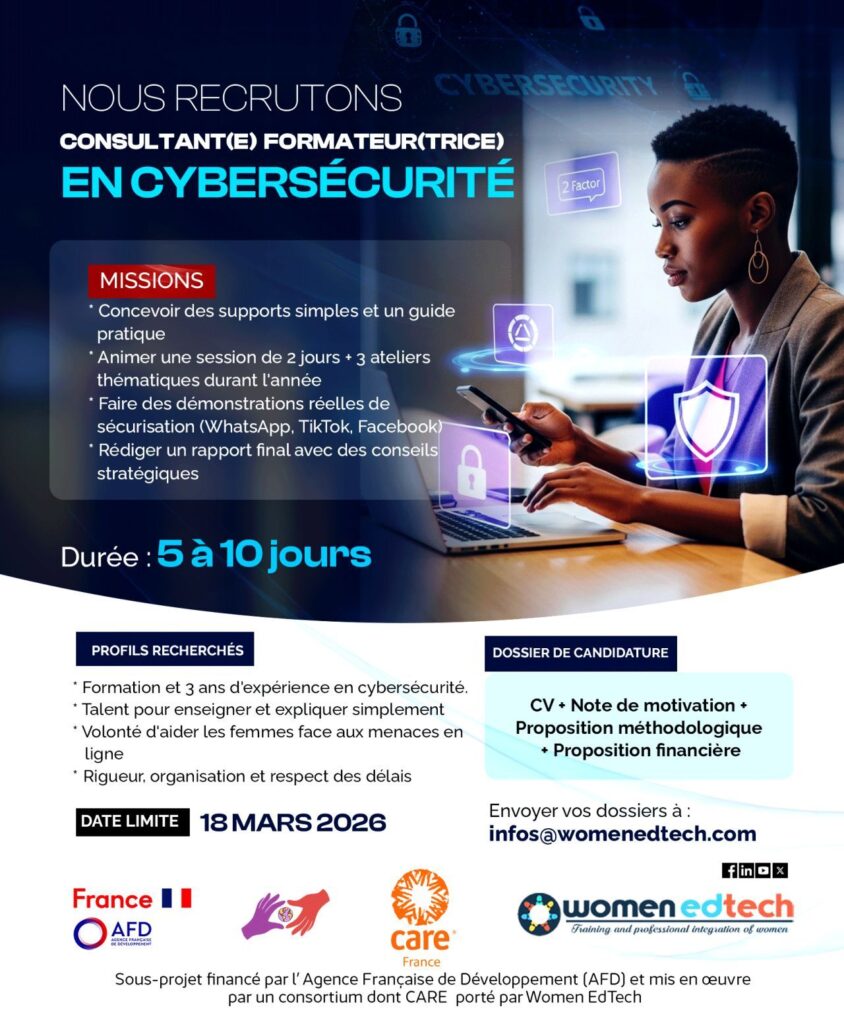
Under the supervision of the Women EdTech project team, the consultant will be responsible for:
- Design the instructional content for training sessions; ;
- Facilitate a training session (2 days) online or in a hybrid format; ;
- Facilitate training sessions (3 days) organized around three thematic days throughout 2026 (examples: Leading a 4-hour session on International Women's Day, March 8 …); ;
- Provide hands-on demonstrations and case studies; ;
- Develop interactive, scenario-based exercises; ;
- Produce a simplified, practical guide to cybersecurity; ;
- Write a final mission report that includes recommendations and outlooks.
| V. Expected Methodology |
The consultant will need to adopt an approach that:
- participatory and interactive; ;
- educational and practice-oriented; ;
- sensitive to gender and protection issues; ;
- non-blaming and focused on empowerment; ;
- tailored to local digital realities.
| VI. Deliverables |
The consultant must submit the following documents (in editable formats and as PDFs):
- Background Note and Detailed Methodology: including an understanding of the Terms of Reference, the implementation schedule, the assessment tools (pre-tests and post-tests), and the module-based training plan.
- Complete “Digital Safe Space” Educational Kit: including presentation materials (PowerPoint or other formats), a simplified training manual for participants, and illustrated “quick reference guides” (pocket-sized or digital) on account security (WhatsApp, TikTok, Facebook).
- Technical content for the platform: a set of educational resources (texts, mini-guides, or video scripts) ready to be integrated into the secure hub safedigital.valueher.bj.
- Training Session Reports: summarizing the proceedings of each session, the attendance list of participants, and the analysis of evaluation results (measuring technical progress from the beginning to the end of the training).
- Final Mission Report: including a comprehensive analysis of the training’s impact, the challenges encountered, and strategic recommendations to strengthen the digital resilience of women and girls in Benin.
| VII. Qualifications Sought |
The candidate must meet the following criteria:
- Education in cybersecurity, information systems security, or a related field; ;
- At least three (03) years of professional experience in cybersecurity; ;
- Proven experience in facilitating training sessions; ;
- A good understanding of the issues related to cyberbullying and digital violence; ;
- Ability to explain technical concepts in layman's terms; ;
- Sensitivity to gender and protection issues; ;
- Diligence, teaching skills, and meeting deadlines.
| VIII. Application Procedures |
Interested candidates are invited to submit:
- An up-to-date resume; ;
- A cover letter explaining their understanding of the mission; ;
- A methodological proposal; ;
- A financial proposal.
Applications should be submitted electronically to the following address:
infos@womenedtech.com
Subject: Job Opening – Cybersecurity Consultant | Digital Safe Space
Deadline: March 18, 2026
Women EdTech strongly encourages applications from women and places particular importance on upholding ethical principles related to sensitive topics.
Recent Articles
-
 Request for Proposals: Women EdTech is seeking suppliers of computer and audiovisual equipment
 -
Are you a travel agency that specializes in organizing business trips to China?
-
Bidding Documents (DAO) No. DAO-2026/WET/BE
-
Recruitment of four (04) candidates to expand the staff
-
Hiring a Firm to Provide Support for PMP Certification





 Français
 English